Fort Lauderdale's Economic Growth Rooted in Long-Term Investment and Wayne Huizenga's Legacy
Fort Lauderdale is establishing itself as a significant hub for long-term investment and business growth, distinguishing itself from other South Florida cities. The city attributes much of its economic trajectory to the lasting impact of H. Wayne Huizenga, who built three Fortune 500 companies—Waste Management, Blockbuster, and AutoNation—from its base. With a focus on discreet wealth, significant waterfront investment, and a strong urban core, Fort Lauderdale has cultivated a robust business environment and a collective momentum that drives its ongoing development.
Fort Lauderdale is carving out a distinct identity in the landscape of American business development, characterized by long-term investment rather than a pursuit of the spotlight. The city's growth is often linked to the foundational legacy of H. Wayne Huizenga, who established three Fortune 500 companies—Waste Management, Blockbuster, and AutoNation—all headquartered in Fort Lauderdale. Huizenga also owned the Miami Dolphins and founded the Marlins and Panthers franchises, leaving a significant mark on the city before his passing in 2018.
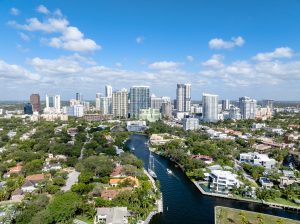
While other Gold Coast cities attract attention with high-profile figures, Fort Lauderdale emphasizes a culture of collective momentum and discreet wealth. Rajiv Jain, chairman of Fort Lauderdale-based GQG Partners, describes the city as a place where executives can connect to Miami without its intensity. The city's appeal includes 165 miles of navigable waterways and over $12 billion in waterfront investment. The Fort Lauderdale International Boat Show, the world's largest in-water boat show, draws over 100,000 visitors and generates nearly $1.8 billion in regional economic impact annually. More superyachts dock in Fort Lauderdale than in Miami or West Palm Beach.
The city's business case is further strengthened by its urban core, which generates $43 billion in annual economic impact. Nearly half of its jobs are concentrated in finance, law, technology, and professional services, a higher share than cities like West Palm Beach, Austin, or Nashville. Fort Lauderdale is also advancing significant developments, including Hines' proprietary T3 office building within FAT Village, a $512 million mixed-use redevelopment. This project will deliver the downtown area's first new ground-up office building in five years, attracting talent and offering space for companies to scale.
The luxury market also recognizes Fort Lauderdale's potential, as evidenced by the recent unanimous approval for a five-story flagship Rolex retailer on Las Olas Boulevard, near the area's first planned five-star boutique hotel. Earlier this year, Huizenga Park reopened following a $15 million transformation, funded by over 100 donors inspired by Wayne Huizenga's legacy. This collective investment ethos, rather than reliance on a single visionary, is identified as Fort Lauderdale's competitive advantage.
(Source: Fortune)
Advertisement
AdSense slot • inline