
Pakistan's Business Community Reacts to SBP Policy Rate Pause at 11.5%
Pakistan's business community largely expressed disappointment on Monday after the State Bank of Pakistan (SBP) decided to keep its policy rate unchanged at 11.5%. Many called for monetary easing in the next Monetary Policy Committee meeting to support economic growth, exports, and industrial recovery, citing easing inflation expectations. In contrast, the Overseas Investors Chamber of Commerce and Industry (OICCI) and the Pakistan Business Council (PBC) described the SBP's decision as a balanced and prudent approach.
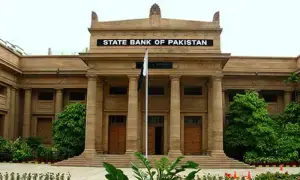
The State Bank of Pakistan (SBP) announced on Monday its decision to maintain the policy rate at 11.5%, a move that drew varied reactions from the nation's business community.
The Federation of Pakistan Chambers of Commerce and Industry (FPCCI) President, Atif Ikram Sheikh, stated that a static double-digit policy rate is detrimental to the country's economic survival. He warned that failure to reduce borrowing costs would accelerate de-industrialisation and undermine export targets, critical for earning foreign exchange. Sheikh also highlighted a perceived disconnect between the central bank and the challenges faced by trade and industry, viewing the decision as unfortunate given expectations of a downward trend in inflation following a US-Iran peace deal facilitated by Pakistan and a gradual normalisation of global energy supplies.
Saquib Fayyaz Magoon, FPCCI Senior Vice President, pointed out that regional competitors operate with significantly lower borrowing costs, making Pakistani exports less competitive globally. He cautioned that maintaining the current rate would penalise both Small and Medium Enterprises (SMEs) and large-scale manufacturing, potentially stalling capacity expansion and job creation. FPCCI Vice President Abdul Mohamin Khan described the status quo as a "recipe for stagnation." The FPCCI urged the government and the SBP governor to reconsider this approach and implement a decisive rate cut in the next Monetary Policy Committee meeting, bringing the rate into single digits.
The Acting President of the Karachi Chamber of Commerce and Industry noted that the business community had strongly anticipated a reversal of the previous 100-basis-point increase and a reduction to single digits, given improving economic indicators and easing global uncertainties. Muhammad Ikram Rajput, President of the Korangi Association of Trade and Industry, stressed that an interest rate reduction is essential under current economic conditions to support business activity, industrial recovery, investment growth, and especially the development of the SME sector.
Conversely, M. Abdul Aleem, Secretary General/Chief Executive of the Overseas Investors Chamber of Commerce and Industry (OICCI), characterised the SBP's decision as a "balanced and pragmatic approach." He suggested that it allows the central bank to assess the impact of earlier measures while avoiding additional pressure on business borrowing costs and investment planning. Aleem also stressed that stability in the policy rate must be accompanied by fiscal discipline, predictable taxation, stronger external buffers, improved energy-sector governance, and faster ease-of-doing-business reforms. Dr. Zeelaf Munir, Chairperson of the Pakistan Business Council (PBC), supported this view, considering the decision to keep the policy rate unchanged as a prudent response to prevailing inflation trends and associated risks.
According to Dawn Pakistan, these reactions followed the SBP's announcement on Monday, June 15th, 2026.

