Pakistan's Finance Minister Details FY27 Budget, Citing Economic Progress
Pakistan's Finance Minister Muhammad Aurangzeb has outlined further details of the proposed budget for FY26-27, calling it a significant step towards economic growth. During a press conference in Islamabad, Aurangzeb highlighted government efforts to foster an export-led economy, including the abolishment of an advance tax and proposed removal of super tax for all exporters following directives from Prime Minister Shehbaz Sharif. The budget also introduces an additional Rs70 billion subsidy for a refinancing scheme and aims to provide relief to lower-income salaried individuals while stimulating key sectors like IT and construction.
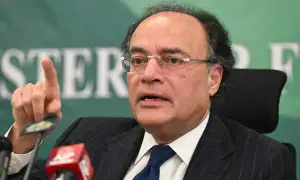
Pakistan's Finance Minister, Muhammad Aurangzeb, addressed a press conference in Islamabad to elaborate on the proposed federal budget for the fiscal year 2026-27. He characterized the budget as a significant advancement towards achieving economic growth, reaffirming the government's commitment to creating an environment conducive to export-led expansion.
Key measures presented include the abolishment of an advance tax. The minister also stressed the decision to abolish the super tax for businesses earning over Rs500 million. Following directives from Prime Minister Shehbaz Sharif, the minister proposed extending the abolishment of the super tax to all exporters. He noted that these discussions extended beyond taxation to include financing considerations.
An additional subsidy of Rs70 billion has been proposed to enhance the existing refinancing scheme. Regarding tariffs, Aurangzeb stated that the government is in the second year of a five-year plan aimed at reducing the cost of intermediate goods and raw materials. He emphasized the importance of narrowing the trade deficit for goods and highlighted the increasing significance of services exports, particularly in the IT sector.
To support the IT industry, freelancers, and PASHA, the government announced its decision to maintain the 0.25 percent Final Tax Regime (FTR). The finance minister also mentioned efforts to provide relief to the lowest segments of the salaried class, citing adjustments in tax slabs from 5pc to 1pc and 15pc to 13pc. Furthermore, he acknowledged the crucial role of housing and construction in driving economic growth within the budget's framework.
The budget, which was presented to the National Assembly on Friday, includes a three-year freeze on provincial transfers. Resources have been reallocated to address security needs and offer relief to salaried, corporate, real estate, and export sectors, aiming to revitalize economic activity. Additional proposals feature taxes on social media earnings, a fixed tax scheme for small traders and shopkeepers, and a higher minimum tax rate for wholesalers and retailers. Incentives are also planned for small electric vehicles and bikes, alongside barriers for luxury electric vehicles.
(Source: Dawn Pakistan)
Advertisement
AdSense slot • inline