Study Challenges Headline Format as Primary Driver for Google Discover Visibility
A comprehensive study analyzing approximately 3.4 million editorial articles suggests that headline format is not the primary factor determining visibility on Google Discover. The research indicates that a headline's perceived effect is largely a proxy for other elements, such as the publishing entity, the target audience, and the specific Discover surface. This challenges conventional wisdom that simple headline rewrites can significantly boost article performance, attributing aggregated trends to phenomena like Simpson's paradox when publisher context is ignored.
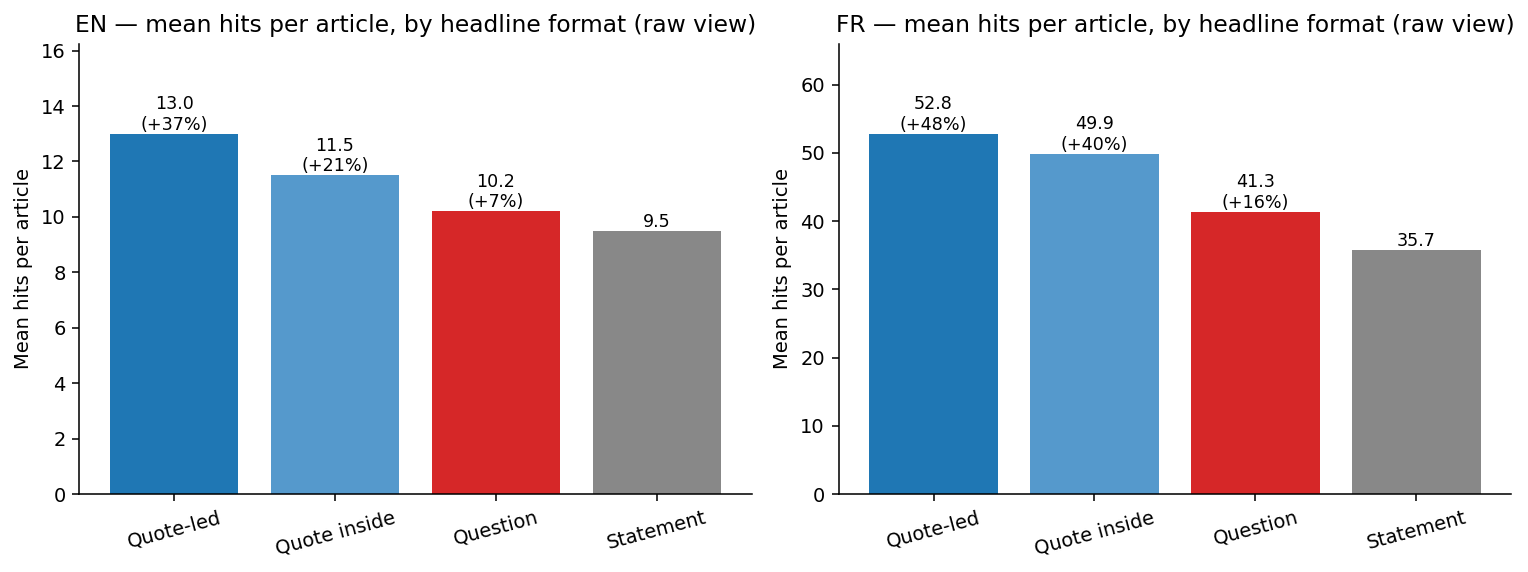
A recent study conducted on 3.4 million editorial articles from the 1492.vision Discover corpus, covering data from November 2025 to May 2026, reveals that headline format may not be a direct cause of increased visibility on Google Discover. The research challenges common claims, such as quote-led headlines outperforming declarative ones or question headlines underperforming.
The study, which analyzed 1,674,518 English and 1,690,295 French articles, measured 'hits per article' as a proxy for visibility, rather than direct clicks from Discover. It focused exclusively on editorial content, excluding platforms like YouTube and X due to their different headline conventions.
Initially, aggregate data across all publishers showed quote-led headlines appearing to perform better, with a +37% lift in English and +48% in French compared to statements. Question headlines also showed a positive lift (+7% in English, +16% in French). However, the study posits that these aggregate figures, which often inform headline advice, can be misleading.
The researchers explain that this phenomenon is an example of Simpson's paradox. When the data is segmented by individual publishers, the strong trends observed in the aggregate weaken or disappear. Publishers that frequently use quote-led headlines, such as celebrity media or buzz-driven sites, often achieve higher Discover visibility irrespective of headline format. Conversely, publishers favoring declarative headlines, like wire services, tend to have lower overall visibility.
According to Search Engine Land, the data suggests headline format acts as a symptom of broader editorial choices—which publisher used it, for which audience, and on which Discover surface—rather than an independent driver of visibility.