
US and Iran Reportedly Agree to Halt War, Sparking 'Collision Course' Between Netanyahu and Trump
Recent reports indicate a significant development in international relations, with the United States and Iran having reportedly reached an agreement to cease ongoing hostilities. This diplomatic step has, according to the news, placed Israeli Prime Minister Benjamin Netanyahu and Donald Trump on a 'collision course,' suggesting a notable divergence in their respective foreign policy strategies and interests concerning the Middle East. The reported agreement between the US and Iran signals a potential de-escalation of tensions, while the friction between the two leaders highlights underlying geopolitical complexities.
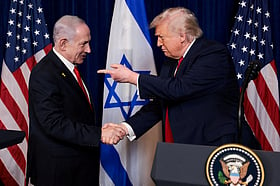
The United States and Iran have reportedly come to an agreement aimed at halting war, according to available information. This reported development signifies a potential shift in the diplomatic landscape surrounding the long-standing tensions between the two nations. The nature and specific terms of this agreement were not detailed in the available report.
Concurrently with this agreement, Israeli Prime Minister Benjamin Netanyahu and Donald Trump are described as being on a 'collision course.' This phrase suggests a significant disagreement or conflicting approaches between the two leaders, particularly in the context of the reported US-Iran understanding. A 'collision course' typically implies a situation where two entities are moving towards potential conflict due to their differing directions or objectives.
The precise reasons for this reported divergence between Netanyahu and Trump were not specified. However, the context of a US-Iran agreement to halt war suggests that the foreign policy implications for Israel, as perceived by Prime Minister Netanyahu, may be at odds with the diplomatic path reportedly taken by the US administration under Donald Trump.
This situation highlights the intricate and often divergent interests among key international players in the Middle East. The reported agreement could reshape regional alliances and strategic considerations, potentially leading to new dynamics in the ongoing efforts to maintain stability and security.
(Source: Prothom Alo English)

