
U.S. Oil Producers and Refiners Experience Soaring Profits Amid Geopolitical Landscape
U.S. oil producers and refiners have seen significant profit and stock price increases, with some leading companies experiencing jumps of 20% to 70% this year. Analysts suggest this rally may extend into 2028, driven by factors including the Iran war, rising global demand to replenish strategic energy reserves, and an increased reliance on Western Hemisphere supplies due to geopolitical unrest. These trends contribute to a sustained higher oil price environment.
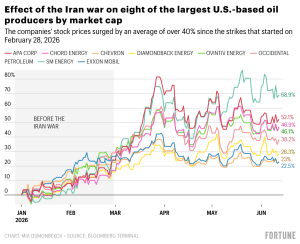
U.S. oil producers and refiners are reporting substantial increases in profits and share prices, emerging as significant beneficiaries in the current global energy market. Stock values for major U.S. oil companies have surged between 20% and 70% this year, with many reaching near all-time highs. This upward trend is attributed to spiking crude prices and demand.
Industry analysts and executives indicate that the higher oil price environment could persist well into 2027 and possibly 2028. Beyond the immediate impact of the Iran war, factors such as rising global oil demand for replenishing strategic reserves and a shift towards Western Hemisphere supplies, driven by geopolitical instability in the Middle East and other regions, are contributing to this outlook.
Chevron Chairman and CEO Mike Wirth noted on June 12 in Houston that the U.S. and the Americas are well-positioned with robust energy resources and access to blue-water ports. This strategic advantage allows them to bypass risky chokepoints like the Strait of Hormuz, potentially making the region a more vital component of the global energy system. Chevron and Exxon Mobil shares are both up approximately 22% this year, having hit all-time highs in late March. Exxon's market capitalization exceeds $600 billion, while Chevron's is over $370 billion.
U.S. shale producers have also experienced substantial gains, with shares of Ovintiv, Chord Energy, and APA Corp. climbing close to 50% year-to-date. SM Energy, which recently acquired Civitas, has surged nearly 70% since January 1. Refiners such as Marathon Petroleum and Valero Energy have seen approximately 60% increases, benefiting from high profit margins on gasoline and jet fuel. Liquefied natural gas (LNG) exporters are also thriving, with Venture Global rallying over 90% and Cheniere Energy jumping about 25% this year.
Despite elevated oil and fuel prices, crude has not reached the $200-a-barrel level that was feared during significant energy supply shocks. Rebecca Babin, a senior equity trader for CIBC Private Wealth, explained that energy markets have relied heavily on emergency reserves since an initial ceasefire announcement in early April, becoming accustomed to market fluctuations. However, these reserves are depleting, and refilling them is expected to take an extended period, thus contributing to sustained higher prices.
The U.S. Strategic Petroleum Reserve (SPR) has been drawn down significantly, reaching its lowest volumes since 1983. As of June 5, 66 million barrels have been drained from the SPR. U.S. crude exports, reduced Chinese imports, and conservation efforts in other countries have helped keep oil prices from spiking even higher.
According to Fortune, the financial success of U.S. energy companies is intertwined with evolving global supply dynamics and geopolitical events.


