Vietnam Emerges as Southeast Asia's Premier Tourist Destination
Vietnam recorded over 21 million visitors in 2025, marking a 20% increase from the previous year. The country surpassed Thailand as the most popular destination for Chinese tourists, attracting 5.3 million. Officials aim to generate $41 billion from tourism this year, a sector that already contributes nearly 10% to the national GDP. To achieve this, Vietnam is investing in infrastructure, expanding visa-free access, and targeting higher-spending travelers such as business, luxury, and medical tourists. New routes are being launched by airlines, and travel to destinations beyond major cities, such as Phu Quoc and Sa Pa, has significantly increased.
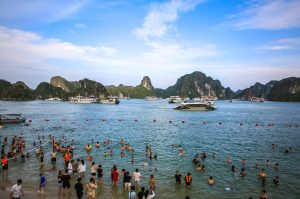
Vietnam is rapidly establishing itself as a leading holiday destination in Southeast Asia. Government statistics indicate that the country welcomed just over 21 million visitors in 2025, representing a 20% increase compared to the prior year. During this period, Vietnam also surpassed Thailand in popularity among Chinese tourists, drawing 5.3 million visitors compared to Thailand's 4.5 million.
The Vietnamese government has set an ambitious goal to generate 1.1 quadrillion Vietnamese dong, equivalent to $41 billion, from its tourism sector this year. Deputy Prime Minister Mai Van Chinh highlighted Vietnam's strategic location and rich cultural heritage, including its diverse cuisines, landscapes, and hospitable people, as key assets for tourism development.
Beyond traditional hubs like Hanoi and Ho Chi Minh City, destinations such as Phu Quoc island and the northwestern town of Sa Pa saw visitor numbers more than double in 2025, according to data from Klook, an Asian travel platform. CS Soong, Klook's vice president of corporate development, noted that tourists are increasingly seeking nature-driven and culturally distinct experiences outside major urban areas.
While Vietnam's economic potential is often associated with its manufacturing sector, tourism's contribution of almost 10% to the GDP underscores the country's growing service sector capabilities. Le Hong Hiep, a senior fellow at the ISEAS–Yusof Ishak Institute in Singapore, stated that Vietnam is competing with Thailand and Malaysia to become the top regional destination. The government is actively working to attract tourists who spend more and stay longer, moving beyond the traditional backpacker segment to target business, luxury, and medical travelers.
The health ministry projects Vietnam's medical tourism industry to grow from $700 million in 2024 to nearly $4 billion by 2033. Conference travel is also expected to expand, with Mordor Intelligence forecasting growth from $7.8 billion to $10.3 billion by 2031.
Increased accessibility is a significant factor in Vietnam's tourism boom. Last year, the country allowed nationals from a dozen countries, including Belgium, Hungary, and Switzerland, to stay for 45 days without a visa. Currently, 39 countries benefit from some form of visa-free access. Alexandra Murray, Vice President and Regional Head of Southeast Asia for Hilton, stated that lifted visa restrictions allow for more spontaneous travel plans.
Vietnamese airlines are also pursuing aggressive international expansion. Vietjet, a leading private airline, is launching new flights from China, Japan, and Singapore, with plans to consider European routes. While China and South Korea remain the largest sources of tourists, data from Klook indicates increasing demand from Filipino and Indian travelers, alongside accelerating long-haul tourism from the U.S., Australia, and New Zealand.
Infrastructure investment is a key government focus. For instance, over $830 million has been allocated for a new airport in Phu Quoc, a project spearheaded by local conglomerate Sun Group and Singapore's Changi Airport Group. These investments are being made in anticipation of the 2027 APEC Summit, which will be held on the island. According to Fortune, these efforts aim to solidify Vietnam's position as a premier tourist destination.