Baldia Factory Fire Victims Demand Reinvestigation After Supreme Court Acquittal
Families of the Baldia Town factory fire victims, joined by labor organizations, gathered in Karachi on Saturday to demand accountability and a reopening of the case, nearly 14 years after the tragedy. Their protest follows a recent Supreme Court verdict that acquitted two Muttahida Qaumi Movement (MQM) activists, Abdul Rehman Bhola and Zubair alias Chariya, who were previously accused of starting the fire on September 11, 2012. The court granted the two men the benefit of doubt, citing insufficient evidence as only one of approximately 400 witnesses claimed to have seen one accused with a chemical bag, but none witnessed the fire being ignited. This decision has renewed calls from the victims' families and labor activists for a thorough investigation into the alleged criminal negligence of factory owners and the failure of relevant government departments to enforce safety laws.
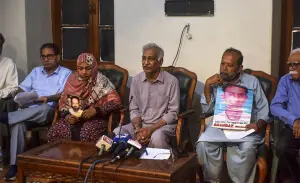
Grieving families of those who died in the Baldia Town factory fire converged at the Karachi Press Club on Saturday, alongside various labor organizations, to seek answers regarding accountability for the loss of their loved ones.
Their demand for justice intensified following a recent decision by a three-member bench of the Supreme Court of Pakistan. The court acquitted two Muttahida Qaumi Movement (MQM) activists, Abdul Rehman Bhola and Zubair alias Chariya, who had been implicated in starting the factory fire on September 11, 2012.
The Supreme Court cited the benefit of doubt, noting that out of roughly 400 witnesses, only one claimed to have seen an accused with a chemical bag, and no witness directly observed the fire being ignited. This ruling has brought the focus back to the long-standing assertions by affected families and labor organizations that the tragedy, which claimed over 260 lives, stemmed from the criminal negligence of the factory owners and the failure of government departments to enforce safety regulations and conduct proper inspections.
Nasir Mansoor, General Secretary of the National Trade Union Federation (NTUF), stated that the case being framed as one of terrorism and extortion prevented scrutiny of the Labour Department, Fire Brigade, Employees' Old-Age Benefits Institution (EOBI), and Social Security institutions. He highlighted that multiple individuals, including certain MQM leaders at the trial court stage and factory security guards by the Sindh High Court, have been acquitted throughout the case's various stages, leading to a situation where no one is held responsible for the deaths.
Labor leaders and activists are now calling for the case to be reopened for a full investigation into the responsibilities and failures of these government bodies. Zehra Khan, Co-chair of the IndustriALL Global Union Textile Garments Sector, reiterated that the Baldia factory case was not tried on its merits and demanded accountability where negligence is proven.
Husna Khatoon, Chairperson of the Ali Enterprises Factory Fire Affectees Association (AEFFAA), who lost her husband in the fire, alleged that most workers died because factory exits and windows were locked and sealed, effectively trapping them inside.
It is on record that the factory owners did not provide direct compensation to the victims. Instead, a system of lifelong monthly pensions, ranging from approximately Rs9,000 to Rs35,000, was established for the affected families through the efforts of labor organizations, lawyers, and international solidarity networks, including the European Centre for Constitutional and Human Rights, Clean Clothes Campaign, and IndustriALL Global Union, with compensation arranged via the German company KIK.
(Source: Dawn Pakistan)
Advertisement
AdSense slot • inline