FIFA President Gianni Infantino's Expanded Influence Faces Scrutiny Amid World Cup Growth
FIFA President Gianni Infantino has significantly expanded the organization's power and its flagship tournaments since taking office in 2016, following a major corruption scandal. As the 2026 World Cup approaches, his leadership draws both praise for its scale and criticism over FIFA's tight control of the sport and event costs. The upcoming tournament, set to be the largest in history, highlights FIFA's growing global footprint under Infantino.
The International Federation of Association Football (FIFA) underwent a period of significant upheaval starting May 27, 2015, when Swiss police arrested seven top officials in Zurich. The arrests followed a U.S. Department of Justice indictment alleging over $150 million in kickbacks and bribes related to the men's World Cup, with then-Attorney General Loretta Lynch describing the corruption as "rampant, systemic, and deep-rooted." This investigation ultimately led to the resignation of longtime FIFA president Sepp Blatter, though he was not indicted. In total, 31 individuals pleaded guilty, with some convictions later overturned.
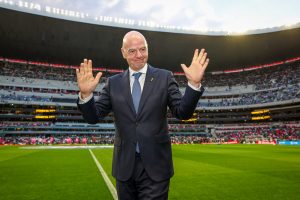
Gianni Infantino, a Swiss-Italian lawyer, was elected FIFA president in February 2016. He campaigned on promises to reform the organization, boost revenue, and restore FIFA's image and respect, vowing to place football "at the center of the stage."
Nearly a decade later, Infantino is central to the organization of the 2026 World Cup, scheduled to kick off on June 11 in Mexico City and conclude on July 19 in New Jersey. The tournament will span 39 days across the U.S., Mexico, and Canada. Infantino has actively promoted the event's expansion and engaged with political figures, including attending former President Trump's second inauguration, a Gaza peace summit in Egypt, and presenting Trump with a "FIFA Peace Prize."
While Infantino's accomplishment in orchestrating such a large-scale event is widely acknowledged, his tenure is not without controversy. Detractors do not allege malfeasance but point to issues such as high ticket prices and substantial costs for host taxpayers. Complaints about FIFA's tight grip on the sport, which predated Infantino's presidency, have also continued. FIFA stated it has "implemented extensive reforms and taken concrete steps to regain its reputation as a credible institution" since 2016. However, former Australian soccer executive Bonita Mersiades described FIFA as "almost too big to fail or too big to pull apart," highlighting the difficulty of overhauling the organization.
Infantino has fulfilled his expansion promises, significantly growing the scale of FIFA's competitions. The 2026 World Cup will feature 48 competing countries, an increase from 32 in the 2022 tournament in Qatar. It will host 104 matches, up from 64, across 16 cities in three countries—a first for FIFA. Additionally, Infantino expanded the Club World Cup, a professional teams' competition, from seven to 32 clubs, with the expanded tournament competing across the U.S. last year.
(Source: Fortune)