NASA Explains the Science of Mass Distribution
Mass distribution, the way an object's mass is spread within it, is a critical concept influencing everything from the shapes of galaxies to the design of aircraft and the rotation of planets. This principle is utilized by scientists and engineers to map stars, determine planetary compositions, and ensure balanced designs for various objects. Understanding how mass is distributed is key to predicting and controlling an object's motion and stability.
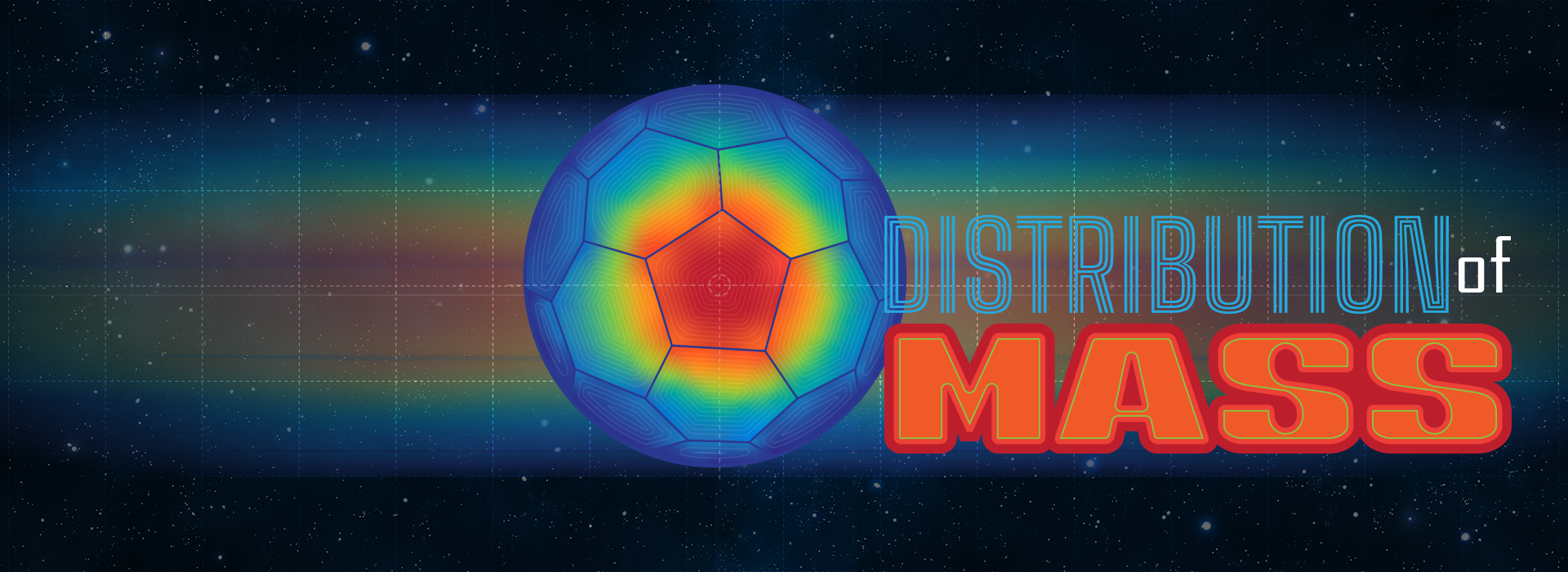
Mass distribution is a fundamental scientific concept that describes how mass is spread within an object. This principle has far-reaching implications, affecting the shapes of galaxies, the design of aircraft, and the rotation of celestial bodies. Engineers and scientists apply this understanding to map stars, deduce the composition of planets, and even to determine how luggage is loaded onto airplanes.
An everyday example illustrating mass distribution is a soccer ball. While a soccer ball appears geometrically simple externally, its internal engineering is complex. The performance of a soccer ball, including its spin and flight trajectory, is significantly influenced by how its mass is distributed internally. Engineers aim for an even balance of mass across all areas of the ball. If the mass is uneven, the ball's center of mass shifts, leading to unpredictable movements such as wobbling or an altered flight path.
Scientists and engineers measure mass distribution using precision scales, computer models, and rigorous testing. Their objective is to achieve dynamic balance, which ensures an object moves smoothly without unexpected deviations. This balance is crucial for designing stable airplanes, rockets, and sports equipment.
Gravity on Earth can obscure certain aspects of object motion, making it challenging to study mass distribution in detail. However, in microgravity environments, such as the International Space Station (ISS), motion can be observed more clearly. In 2019, Adidas collaborated with NASA to send soccer balls to the ISS. Astronauts conducted experiments that helped engineers validate their designs and gain a deeper understanding of the physics behind ball motion, leading to improvements in the accuracy and consistency of modern soccer balls.
Careers in fields like Computer-Aided Design (CAD) Technician/Drafter, Computational Fluid Dynamics Engineer, and Physicist involve exploring the science and engineering of mass distribution. These professionals develop technical drawings, model fluid behavior around designs, and study matter and energy to understand the universe through mathematical models and experiments.
(Source: NASA Breaking News)
Advertisement
AdSense slot • inline
