Pakistan Finance Minister Outlines Strategy for Tax Net Expansion and Budget Goals
Pakistan's Finance Minister Muhammad Aurangzeb affirmed the government's commitment to reducing the tax burden on specific segments of society by broadening the tax net, following the presentation of an Rs18.8 trillion budget for the upcoming fiscal year. He detailed a two-pronged strategy involving 'tax deepening' to address leakages and evasion, and 'tax broadening' to expand the tax base. Aurangzeb confirmed that no new taxes were introduced for the next fiscal year and highlighted reforms for the Federal Board of Revenue (FBR), including the adoption of AI-led mechanisms.
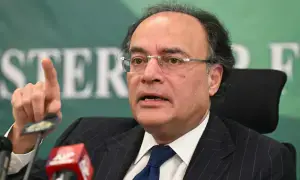
Finance Minister Muhammad Aurangzeb on Friday reiterated the government's commitment to reducing the disproportionate tax burden on certain classes by expanding the national tax net. This statement came after the unveiling of an Rs18.8 trillion budget for the next fiscal year.
Aurangzeb indicated that the government had sought to provide relief to various sectors, including exporters, manufacturers, the IT sector, construction, and the salaried class. He stated that the identified direction of travel involves continuous efforts to reduce the disproportionate tax burden through a wider tax net.
To expand the tax net and ensure compliance, the finance minister outlined a twofold strategy: 'tax deepening' and 'tax broadening'. Tax deepening, he explained, involves fixing leakages, combating corruption, and fighting tax evasion through compliance and enforcement. He expressed confidence that this approach would yield significant benefits. The government also intends to structurally advance its efforts to broaden the tax net.
Discussing the provinces’ share and proposed reductions in development funds, Aurangzeb noted that two provinces, Khyber Pakhtunkhwa and Balochistan, were experiencing internal disorder. He stated that empowering security forces, particularly civil armed forces, was deemed necessary, which led to a request for provincial contributions. The finance minister also extended gratitude to all provincial governments for their cooperation with the federal government on strategic measures.
Aurangzeb emphasized that the government did not announce new taxes for the next fiscal year. He acknowledged challenges faced by the Federal Board of Revenue (FBR) and disclosed ongoing efforts to replace traditional workflows with AI-led mechanisms, aiming for "zero human intervention."
During the budget presentation in the National Assembly, Aurangzeb stated that the budget for the coming year was prepared with a clear and purposeful strategy, prioritizing increased production capacity and the promotion of exports. This includes granting tax concessions to large industries and providing resources to exporters through the Export Financing Scheme.
The finance minister also affirmed the government's focus on increasing revenues through tax enforcement and compliance, rather than burdening the public with higher taxes. To achieve this, changes are being made to compliance and enforcement mechanisms, alongside reforms within the FBR.
Regarding the ongoing conflict involving the United States, Israel, and Iran, Aurangzeb expressed hope for the success of efforts by Prime Minister Shehbaz Sharif and Field Marshal Asim Munir. However, he cautioned that the economic impact of this conflict is expected to continue into the next fiscal year.
According to Dawn Pakistan, these remarks were made by Muhammad Aurangzeb during a Geo News program.
Advertisement
AdSense slot • inline