
Trump Open to Congressional Review of Iran Deal Amid Lawmaker Scrutiny
U.S. President Donald Trump has indicated his readiness to submit the recently negotiated Iran agreement to Congress for review. This comes as both Republican and Democratic lawmakers are demanding access to the full terms of the deal, which remain undisclosed. The agreement, expected to be formally signed on Friday by Vice President JD Vance, aims to conclude four months of military confrontation between Washington and Tehran and restore access to the strategically vital Strait of Hormuz.
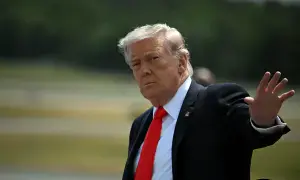
U.S. President Donald Trump indicated his willingness on Tuesday to submit the recently negotiated Iran agreement to Congress for review. This development comes as lawmakers from both Republican and Democratic parties are demanding access to the full terms of the deal, which remain undisclosed. Trump made these remarks during a meeting with United Arab Emirates (UAE) President Mohammed bin Zayed Al Nahyan in France.
The agreement was announced over the weekend and is anticipated to be formally signed in Geneva on Friday by Vice President JD Vance. It was electronically signed by President Trump and Vice President Vance on Sunday. The accord is intended to conclude four months of military confrontation between Washington and Tehran and to reopen the strategically vital Strait of Hormuz.
The administration has not yet released the text of the Memorandum of Understanding (MoU), leaving lawmakers without clear information regarding the future of Iran’s nuclear program, potential sanctions relief, and verification mechanisms. This secrecy has led to calls for greater transparency on Capitol Hill, with some drawing parallels to the debate surrounding the 2015 Joint Comprehensive Plan of Action (JCPOA).
Senate Majority Leader John Thune stated that lawmakers currently lack sufficient information to evaluate the agreement. He raised concerns about compliance, enforcement, and the financial incentives Iran might receive. Senator Lindsey Graham emphasized the need for lawmakers to examine the agreement before endorsing it, noting that any nuclear deal with Iran would require congressional review and approval.
Assessments published in *Foreign Affairs* by Narges Bajoghli and Vali Nasr suggest that the conflict did not achieve its objective of fundamentally weakening the Iranian state, instead transforming it in unexpected ways. These analyses have contributed to conservative concerns that the administration might accept a framework that retains elements of Iran's nuclear infrastructure while offering significant economic relief to Tehran.
Democrats welcomed the efforts to end the conflict but criticized the administration's initial decision to engage in war. Senate Democratic Leader Chuck Schumer urged the White House to provide a full briefing to Congress, arguing that the U.S. is "worse off than before Trump began this foolish war of choice." Senator Jack Reed noted that the proposed agreement appears to offer fewer restrictions on Iran's nuclear program compared to the Obama-era JCPOA, despite the conflict's costs, including billions of dollars spent and 14 American personnel killed. Representative Seth Moulton described the emerging arrangement as "basically a surrender document."
The Trump administration maintains that the agreement represents a significant diplomatic achievement, ending hostilities and restoring maritime traffic through a crucial energy corridor. However, key contentious issues, such as the fate of Iran’s enriched uranium stockpile and the scope of sanctions relief, reportedly have been deferred to follow-on negotiations expected over the next 60 days. This uncertainty suggests the deal could become the focus of a major congressional debate.
According to Dawn Pakistan.

