
UK MP Hamish Falconer Affirms Pakistan's Right to Self-Defense, Calls for Dialogue with Afghanistan
British Parliamentary Under-Secretary Hamish Falconer stated on Monday that Pakistan has the right under international law to defend itself against attacks originating from Afghanistan. During a visit to Islamabad, Falconer stressed the need for dialogue and regional stability amidst rising tensions, where Pakistani authorities link recent violence to terrorist groups from Afghan territory. He conveyed condolences for recent casualties and discussed security concerns, regional issues, and UK-Pakistan relations with senior Pakistani officials, including Deputy Prime Minister Ishaq Dar.
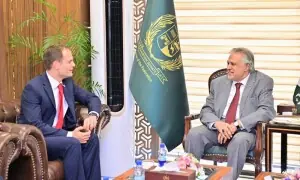
British Parliamentary Under-Secretary for the Middle East, Afghanistan, and Pakistan, Hamish Falconer, affirmed on Monday that Pakistan holds the right under international law to defend itself against attacks originating from Afghanistan. Speaking during his visit to Islamabad, Falconer underscored the importance of dialogue and regional stability to address ongoing security concerns.
The British official stated that any country facing cross-border threats is entitled to protect its citizens within the framework of international law. His remarks come as tensions rise and incidents of violence occur, which Pakistani authorities attribute to terrorist groups operating from Afghan territory.
Falconer expressed condolences over the recent loss of life in Pakistan, describing the security situation as deeply concerning. He highlighted that challenges faced by Islamabad are not isolated, but have wider regional implications, with security threats emanating from Afghanistan potentially affecting neighboring countries and beyond. He emphasized the necessity for all stakeholders to collaborate towards sustainable solutions.
During his meetings with Pakistan’s leadership, including Deputy Prime Minister and Foreign Minister Ishaq Dar, discussions covered a range of regional and global issues. These included recent developments surrounding a ceasefire involving Iran, efforts to ensure stability in the Strait of Hormuz, and the importance of maintaining uninterrupted global trade routes. Afghanistan was also a key focus, described by the British official as central to regional peace and security.
Acknowledging Pakistan’s concerns, Falconer noted that British authorities have been in close contact with their Pakistani counterparts to better understand the evolving situation. He reiterated that preventing further escalation should be a priority and emphasized the importance of diplomatic engagement between Islamabad and Kabul to address mutual security concerns. He recognized Pakistan’s frustrations over the current state of bilateral coordination with Afghanistan, stating that a shared understanding is crucial to ensure territories are not used to harm each other.
The longstanding relationship between Pakistan and the United Kingdom was also a significant topic, with Falconer describing their ties as “deep and enduring,” built on strong community links. Regarding Afghan refugees in Pakistan, he stressed the importance of upholding international legal standards while acknowledging the complexities, noting it is primarily a matter for Pakistan and Afghanistan to address jointly. Falconer concluded that his trip reinforced cooperation and deepened mutual understanding, expressing hope for continued engagement on critical regional challenges.
According to Dawn Pakistan, these statements were published on June 16th, 2026.
