AOL Co-founder Steve Case Discusses AI Opportunities, Risks, and Job Impact
Steve Case, co-founder of AOL and CEO of Revolution, recently spoke at Fortune’s 25th annual Brainstorm Tech conference. He highlighted the significant opportunities presented by artificial intelligence but expressed concerns regarding its potential impact on the workforce, suggesting a “net negative” for jobs. Case also addressed the challenges of AI governance due to its rapid development, drawing parallels between ChatGPT's quick user adoption and AOL's early growth. He warned against both excessive regulation and an unregulated "let it rip" approach, advocating for a balanced policy over the long term.
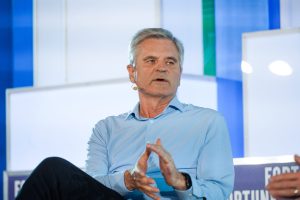
AOL co-founder and Revolution CEO Steve Case sees immense potential in artificial intelligence but harbors reservations about its effects on employment. Speaking at Fortune’s 25th annual Brainstorm Tech conference in Aspen, Case stated that achieving balance in AI development will likely involve navigating a "messy middle" ground.
Case criticized the European Union's approach to slowing AI development, arguing it could impede innovation and America's global leadership against competitors like China. Conversely, he deemed an entirely unregulated "let it rip" approach as reckless and irresponsible.
While acknowledging the benefits of AI, particularly from his investments in healthcare, Case expressed uncertainty about its workforce impact. He predicted that AI would be "probably a net negative" for jobs, though he stated, "we’ll see how it plays out."
He noted the difficulty of governing AI due to its rapid spread, citing ChatGPT's surge to 100 million users shortly after its launch as a "Netscape moment." This contrasts with AOL's growth to 184,000 users over seven years before reaching 30 million. This rapid adoption places significant pressure on governments globally. Case anticipates that public and governmental pressure regarding AI will become a prominent issue in the 2028 U.S. elections.
Case observed that many Americans are not enthusiastic about AI, evidenced by protests against data centers and negative reactions at commencement speeches. He cautioned against Silicon Valley's "trust us, it’s all going to be fine" message, suggesting it would fail to resonate with the public. He advised executives to view AI policy as a 10-to-20-year endeavor, warning that the current administration's light regulatory touch may not be permanent and that a potential "FDA for AI" could emerge.
Despite these concerns, Case shared optimism about the political climate, drawing on his 30 years living near Washington, D.C., and his experience employing figures such as Ron Klain and J.D. Vance. He believes the current "hyper partisan" political landscape will eventually subside, allowing for productive collaboration.
According to Fortune, Case's remarks came during the publication's 25th annual Brainstorm Tech conference.