G7 Leaders Address Dependence on U.S. AI and Chinese Supply Chains
Leaders from the Group of Seven (G7) nations are convening in a French Alpine town to discuss global challenges, with a notable focus on their increasing reliance on U.S. artificial intelligence technologies and critical Chinese supply chains. Concerns have emerged over U.S. export controls on advanced AI models, which have reportedly caused frustration among allies. Simultaneously, China's significant control over critical minerals essential for clean energy and overall manufacturing capacity presents another key dependency, shaping discussions around economic imbalances and national security.
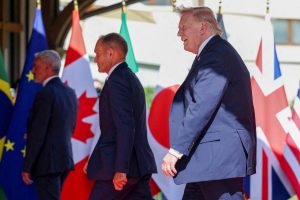
The G7 summit, held in a French Alpine town, brings together leaders from the world's seven largest and wealthiest democracies to address pressing global issues, including the situations in Ukraine and the Middle East. However, the agenda also highlights two interconnected anxieties for the Group of Seven: their dependence on China's supply chains and their reliance on the United States' artificial intelligence capabilities.
A central point of discussion concerning AI is the U.S. decision to impose export controls on frontier models like Anthropic's Fable 5 and Mythos 5. According to Andrea Renda, research director at the Centre for European Policy Studies, this move has caused annoyance among the other G7 members. Renda suggests it could mark an era where U.S. AI is used as a strategic tool, potentially against traditional allies.
Despite the presence of leading AI CEOs, including OpenAI's Sam Altman, Anthropic's Dario Amodei, and Meta's Alex Wang, experts believe that achieving the summit's goals for AI alignment among G7 nations may be challenging. Agathe Demerais, a senior policy fellow at the European Council on Foreign Relations, noted that the U.S. and China are the dominant AI powers, leaving limited room for other G7 economies to play a leading role.
China's influence extends to another critical dependency: manufacturing and supply chains. While China is not a G7 member, its status was signaled by an "unprecedented" call between French President Emmanuel Macron and Chinese President Xi Jinping ahead of the summit. This engagement reflects Macron's effort to leverage the U.S.-China rivalry, positioning China as a significant, though absent, presence in the G7 discussions, according to Alisha Chhangani of the Atlantic Council's GeoEconomics Center, and Matt Pearl of the Center for Strategic and International Studies.
The G7 agenda's theme of "reducing global imbalances" is understood to implicitly address China's industrial overcapacity and trade deficits. China's control over critical minerals vital for green energy technologies also creates a dependency that could foster protectionist policies and heighten national security concerns among U.S. allies, as outlined in a memo prepared for the G7 by leading economists. The U.S. and China collectively control 90% of global computing power and attract the majority of AI investment, with nearly eight in ten AI companies started last year in the G7 based in the U.S., according to Stanford’s 2026 AI Index report.
For Europe, deciding which dependency—on U.S. software for AI infrastructure or on China for the physical layer underpinning AI and clean energy—is more crucial to resolve presents a significant challenge, Pearl indicated.
According to Fortune, these interwoven dependencies on U.S. AI and Chinese supply chains are "making China the elephant in the room" at the G7 summit. (Source: Fortune)