NVIDIA Lab's AI Agents Autonomously Direct Robot Training
Researchers at NVIDIA's Generalist Embodied Agent Research (GEAR) lab have demonstrated a system where AI coding agents autonomously direct robot training. This initiative allows robots to learn intricate tasks, such as cutting zip ties and precisely inserting GPUs into thin motherboard sockets, with minimal human intervention. The system is powered by a new agent harness framework called ENPIRE, co-developed with Carnegie Mellon University and the University of California, Berkeley, which provides AI models with essential tools, memory, context, and feedback loops.
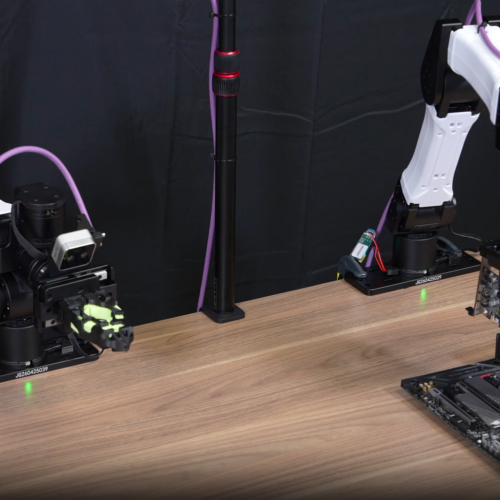
A new advancement in robotics allows AI coding agents to autonomously design training regimens for robotic arms. This capability, demonstrated by NVIDIA’s Generalist Embodied Agent Research (GEAR) lab, along with collaborators from Carnegie Mellon University in Pittsburgh and the University of California, Berkeley, showcases AI's potential for self-directed learning in robotic systems.
The AI agents were provided with robotic arms, compute resources, and a "generous token budget," subsequently figuring out training protocols. These protocols enabled the robots to successfully perform tasks such as cutting zip ties and accurately inserting GPUs into delicate sockets on motherboards.
This autonomous robot training is facilitated by ENPIRE, a newly developed agent harness framework. ENPIRE is a software wrapper that enhances AI models by integrating various tools and providing capabilities like memory, context, constraint, and feedback loops, allowing for a more sophisticated and independent learning process.
Jim Fan, director of AI at NVIDIA, highlighted the system's efficiency, stating, “A part of our NVIDIA GEAR lab now self-improves tirelessly overnight. We just read the reports in the morning.” This suggests a shift towards more autonomous development cycles in robotics research.
(Source: Ars Technica)