Pakistan's Finance Minister Presents FY26-27 Budget, Cites Progress Towards Economic Growth
Pakistan's Finance Minister Muhammad Aurangzeb has detailed the proposed budget for fiscal year 2026-27, describing it as a "significant progress" on the path to economic growth. During a press briefing in Islamabad, Aurangzeb outlined comprehensive efforts to foster an export-led economy, including the proposed abolishment of the super tax for all exporters and businesses earning over Rs500 million, following directives from Prime Minister Shehbaz Sharif. The budget also proposes an additional Rs70 billion subsidy for a refinancing scheme and maintains the 0.25% Final Tax Regime for the IT industry.
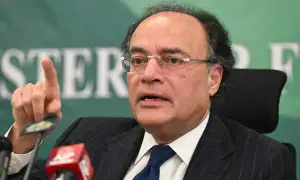
Pakistan's Finance Minister Muhammad Aurangzeb announced the proposed budget for fiscal year 2026-27, emphasizing it represents "significant progress" towards economic growth. Speaking at a press conference in Islamabad, Minister Aurangzeb detailed the government's initiatives to create an enabling environment for export-led growth, referencing the prior abolishment of an advance tax.
The minister highlighted a key proposal to abolish the super tax for businesses earning more than Rs500 million. He further stated that, under the directives of Prime Minister Shehbaz Sharif, the abolishment of the super tax has been proposed for all exporters. Aurangzeb noted that the budget also addresses financing, not just taxation, and proposes an additional subsidy of Rs70 billion to enhance the ongoing refinancing scheme.
Regarding tariffs, the minister indicated that the government is in the second year of a five-year plan aimed at reducing costs for intermediate goods and raw materials. He underscored the importance of reducing the trade deficit for goods and the increasing significance of services exports, particularly in the IT sector. Consequently, the government has announced the maintenance of the 0.25% Final Tax Regime (FTR) for the IT industry, freelancers, and PASHA.
The budget also seeks to provide relief to lower-income salaried individuals by adjusting tax slabs, moving from 5% and 15% to 1% and 13% respectively. Aurangzeb also mentioned the vital role of housing and construction in achieving economic growth objectives.
Earlier on Friday, the finance minister presented the financial plan to the National Assembly. This plan includes a three-year freeze on provincial transfers and a reallocation of resources to address security needs and provide relief to the salaried, corporate, real estate, and export sectors to stimulate economic activity.
This marks the minister's third budget and the fifth for the major coalition partners. Other proposals in the budget include taxes on social media earnings, a fixed tax scheme for small traders and shopkeepers, a higher minimum tax rate for wholesalers and retailers, incentives for small electric vehicles and bikes, and barriers for luxury e-vehicles.
According to Dawn Pakistan, these measures are intended to revive the struggling economy.