$14.2 Million Lincoln Memorial Reflecting Pool Renovation Sees Algae Return; Details Emerge on Iran Conflict and New Deal
Recent renovations to the Lincoln Memorial Reflecting Pool, costing $14.2 million under the Department of the Interior, concluded in April 2026 but saw algae reappear days later, necessitating workers to apply hydrogen peroxide. The project, initiated by former President Trump, significantly exceeded its initial cost estimate. Concurrently, direct military conflict involving the U.S. and Israel against Iranian sites began on February 28, 2026, with evolving objectives. A new preliminary deal with Iran has reportedly been struck, involving substantial financial provisions and sanctions relief.
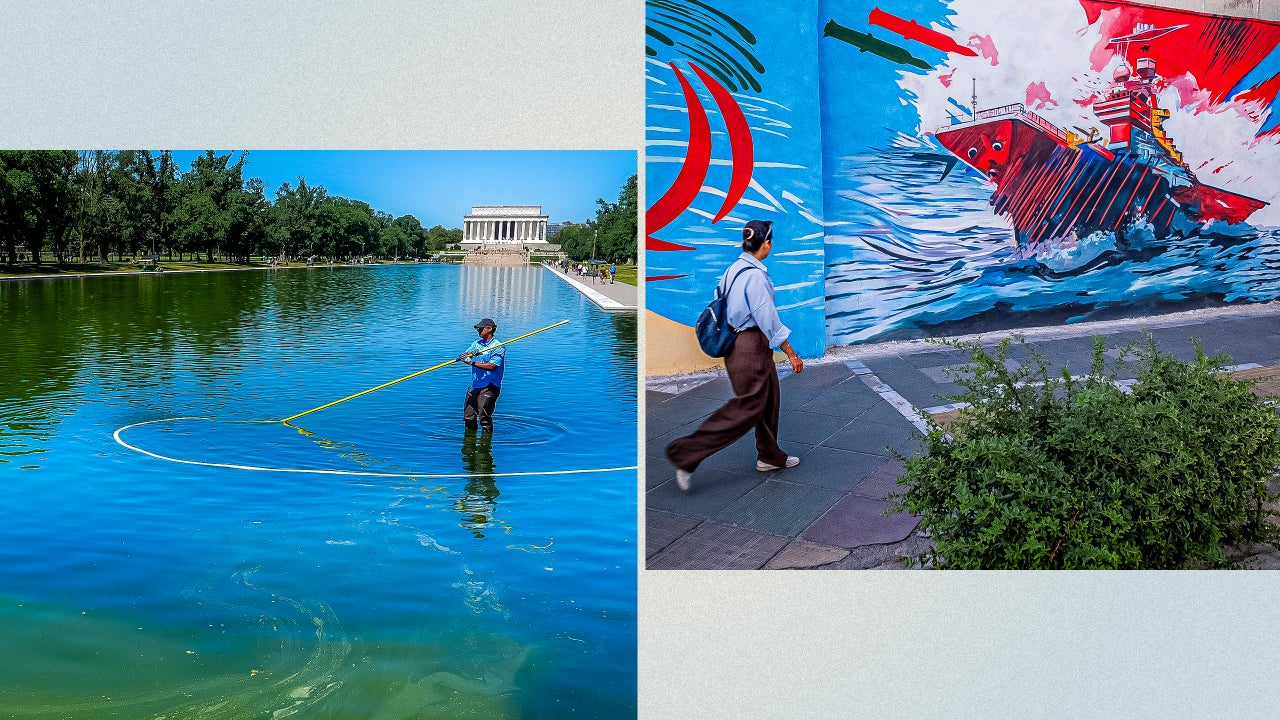
Recent renovations to the Lincoln Memorial Reflecting Pool, overseen by the Department of the Interior, totaled $14.2 million. The project, which commenced in April 2026, incorporated “high-tech nanobubble ozone technology.” Days after its completion, workers were observed applying hydrogen peroxide to the water to address a reappearance of algae.
Former President Trump initiated the renovation in April 2026, describing the pool as “filthy” and proposing a rapid, inexpensive transformation. A no-bid contract was awarded to a team that had worked on pools at his golf club in Sterling, Virginia. Trump initially projected the cost at “$1.5 million to $2 million,” stating a desire for the work to be completed before “the country’s 250th festivities this summer.”
Within weeks of its launch, the project's cost increased to $13.1 million, eventually reaching $14.2 million. The scope expanded beyond the initial plans to repair leaking joints, waterproof the bottom, and paint the pool “American flag blue.” Additional work included exterior surfaces, surrounding areas of the six-acre basin, a new purification system, and deep cleaning. The pool, constructed in the 1920s on marshland, had previously undergone a $34 million renovation between 2010 and 2012, which improved circulation and water loss but did not resolve chronic algae issues.
Separately, direct military conflict involving the U.S. and Israel against Iranian nuclear sites, military infrastructure, and top leadership began abruptly on February 28, 2026. Former President Trump framed the operation, named "Epic Fury," as a defensive measure and a catalyst for Iranian liberation. No specific reason for the timing of the attacks was disclosed, and congressional approval was sidestepped. Trump initially stated the conflict, which he called “a little excursion,” would last “four to five weeks,” but it continued for at least 15 weeks.
The stated objectives for the conflict evolved from primarily targeting Iran’s nuclear capabilities and liberating the Iranian people to aiming for “unconditional surrender.” During the conflict, Iran sustained a blockade of oil ships through the Strait of Hormuz, which led to an increase of over $1 per gallon in gas prices and other economic effects. Opening the Strait of Hormuz subsequently became a primary goal for the Trump administration.
In 2018, the Trump administration withdrew from the Joint Comprehensive Plan of Action (JCPOA), an agreement negotiated by former President Obama with Iran in 2015. Trump had claimed the U.S. provided a $150 billion payout, a claim disputed by the U.S., and asserted that the agreement merely delayed Iran’s nuclear program. More recently, a preliminary deal was reportedly struck with Iran. This agreement is said to involve “ensuring financing of $300 billion” for Iran, “ending all types of sanctions,” and making fully available an undisclosed amount of “frozen funds and assets.”
(Source: Fast Company)