Pakistan Senate Committee Debates Finance Bill 2026 Amid Auto Sector Irregularities
Pakistan's Senate Standing Committee on Finance and Revenue, chaired by Saleem Mandviwalla, continued its clause-by-clause review of the Finance Bill 2026, marked by heated discussions over alleged irregularities in the automobile sector. Senator Faisal Vawda claimed a Rs125 billion loss to the exchequer due to delays in used vehicle imports, leading to an assurance of investigation from Federal Minister for Science and Technology Khalid Magsi. The committee also recommended relief for exporters, proposed abolishing sales tax on educational stationery, and called for a review of electricity fixed charges, while a separate National Assembly committee raised concerns about taxation policies.
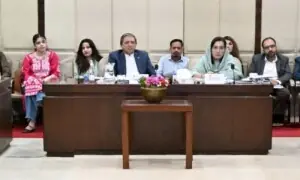
A parliamentary committee in Pakistan, the Senate Standing Committee on Finance and Revenue, experienced significant debate on Tuesday regarding alleged irregularities within the automobile sector. Chaired by Saleem Mandviwalla, the committee continued its clause-by-clause review of the Finance Bill 2026.
Senator Faisal Vawda presented claims of a Rs125 billion loss to the national exchequer over an eight-month period. He attributed this loss to delays in the commercial import of used vehicles. In response, Special Assistant to the Prime Minister on Industries, Haroon Akhtar Khan, criticized what he termed “one-sided allegations.” Federal Minister for Science and Technology, Khalid Magsi, assured the committee that an investigation into the matter would be conducted.
Among its recommendations, the Senate committee proposed the withdrawal of an Engineering Development Board notification concerning quality compliance for used vehicle imports. It also suggested abolishing sales tax on educational stationery, with Senator Mohsin Aziz specifically calling for a zero-percent rate, arguing that the existing tax increases household education costs.
Furthermore, the committee recommended bringing exporters under the Final Tax Regime (FTR) and further rationalizing the tax structure to support export-led growth and foreign exchange earnings. Javed Balwani of the Karachi Chamber of Commerce and Industry urged a 1 percent FTR rate. While Senator Mohsin Aziz supported this, Senator Talha Mahmood opposed even a 1 percent advance tax, warning it could harm exports, and instead demanded a 0.5 percent rate.
The issue of tax refunds was also discussed, with Senator Abdul Qadir complaining about delays from the Federal Board of Revenue (FBR). Finance Minister Muhammad Aurangzeb contested this, stating that payments were being made. Mr. Balwani noted that the FASTER system had improved refund disbursement compared to the previous year.
Separately, the National Assembly Standing Committee on Finance and Revenue, led by MNA Naveed Qamar, advocated for fair taxation, proportionate enforcement, and stronger safeguards for taxpayers. This committee expressed concerns regarding steep penalties, expanded enforcement powers, and the continued reliance on advance and withholding taxes. The Senate committee additionally recommended a review of electricity fixed charges.
According to Dawn Pakistan, these discussions took place on June 17th, 2026.