Pakistan PM Shehbaz Sharif Hails Federal Budget as "People-Friendly" and Export-Oriented
Prime Minister Shehbaz Sharif has described Pakistan's federal budget for fiscal year 2026-27 as "people-friendly" and expressed optimism that it will foster an "export-oriented" economy. During a meeting with women parliamentarians from the PML-N, Sharif highlighted the budget's provisions for women's empowerment and inclusion, designating it a government priority. He also underscored the importance of regional peace, noting Pakistan's peace efforts in the US-Iran conflict and acknowledging contributions from key officials like Field Marshal Asim Munir. The government announced a three-year freeze on provincial transfers, reallocating resources for security and relief measures across various sectors.
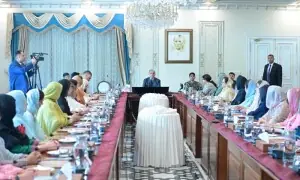
Prime Minister Shehbaz Sharif on Wednesday characterized the federal budget for fiscal year 2026-27 as "people-friendly" and conveyed his hope that it would cultivate an "export-oriented" economy. His remarks were made during a meeting with women parliamentarians from the Pakistan Muslim League-Nawaz (PML-N), where he thanked them for their engagement in the ongoing budget debate. According to a press statement from the Prime Minister’s Office (PMO), Sharif anticipated that the public would benefit from the "relief-oriented" budget once regional peace is established.
The Prime Minister emphasized that the budget introduces measures to empower women and enhance their mainstream inclusion, declaring this a "top priority" for the government. He also referenced Pakistan’s peace initiatives in the US-Iran war and extended gratitude to nations that supported Pakistan throughout the peace process. Sharif specifically commended Field Marshal Asim Munir, Deputy Prime Minister and Foreign Minister Ishaq Dar, and Interior Minister Mohsin Naqvi for their roles in the peace efforts, asserting that lasting regional peace is crucial for economic prosperity in Pakistan and other countries. He recalled government actions, including a Rs128 billion subsidy and an austerity drive launched in March, aimed at protecting the public from global inflation stemming from the US-Iran crisis.
For the upcoming fiscal year's budget, the government plans to prioritize national interests, particularly increasing water resources, information technology (IT), agriculture, and minerals, to build a strong foundation for the Pakistani economy. Women parliamentarians, including Syeda Nosheen Iftikhar, Begum Tehmina Daultana, Shaista Khan, Tahira Aurangzeb, Shaista Pervaiz, and Muneeba Iqbal, commended Prime Minister Sharif for his involvement in the US-Iran negotiation process and the budget’s provisions for women's development. The meeting was also attended by Defence Minister Khawaja Muhammad Asif, IT Minister Shaza Fatima Khawaja, and Parliamentary Affairs Minister Dr Tariq Fazal Chaudhry.
The budget includes a three-year freeze on provincial transfers, with resources reallocated for security needs and relief measures targeting the salaried, corporate, real estate, and export sectors. Proposed tax measures include levies on social media earnings, a fixed tax scheme for small traders and shopkeepers, and a higher minimum tax rate for wholesalers and retailers. Incentives are offered for small electric vehicles and bikes, while barriers are imposed on luxury e-vehicles. Finance Minister Muhammad Aurangzeb stated the budget's strategy focuses on increasing productivity and promoting exports.
Information Minister Attaullah Tarar described the budget as "positive and relief-oriented." He highlighted government efforts to stabilize the economy and implement reforms in the Federal Board of Revenue (FBR), including digitizing systems, merit-based hiring, and establishing a "faceless system" for customs clearance. Tarar reported significant tax collections, including Rs60 billion from sugar mills through IT systems and efforts against illegal trade in the tobacco industry, which reportedly had a Rs200 billion leak. He also noted Rs800 billion recovered through enforcement in the past year, attributing this to PM Shehbaz's personal efforts, independent of the IMF program.
Regarding tax relief, Tarar mentioned a 1% tax for those earning between Rs50,000 and Rs100,000, reduced taxes for higher income slabs and 5-10 marla house purchases, and Rs90 billion disbursed under the "Apna Ghar" scheme. Exporters will see the abolition of advance tax and super tax. State Minister for Finance Bilal Azhar Kayani echoed these sentiments, noting relief for various sectors and the abolition of the 'pink tax'.
According to Dawn Pakistan, these statements underscore the government's economic strategy and budgetary priorities.